

|
|

Page 2 of 3:
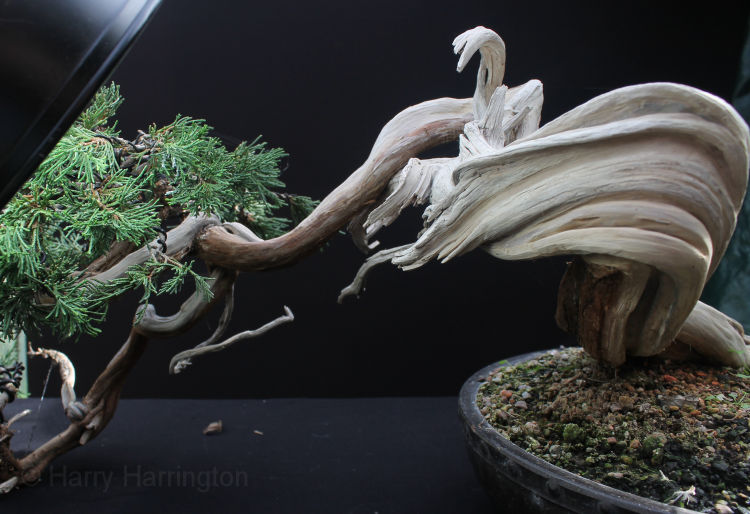
The Sabina Juniper after whitening the deadwood with lime-sulphur.
With the initial hand-carving completed, I misted the wood with water before applying lime-sulphur to whiten it. (Lime-sulphur is more easily absorbed into damp wood). Personally I find that whitening the wood is helpful to the styling process as the uniform colour makes the shapes and lines, and mistakes, in the carving more distinct. Above it is possible to see where the lowest edge of the curved trunk still looked man-made and required further refinement.
.jpg)
Detail of the carving at the back of the Juniper sabina bonsai.
.jpg)
Detail of the hand-carved branch stump.
.jpg)
Detail of the base of a second, raw, Juniper sabina bonsai.
A second example of hand-carving deadwood; on another yamadori Juniper sabina. Again, this old wild tree from Spain featured some spectacular naturally spiralling deadwood and very old, flaking bark.
.jpg)
The Juniper after I began to clean the layers of old bark using a draw-knife and brass brushes.
.jpg)
The Sabina from my preferred front view.